Share Hoylake Drive traffic calming on FacebookShare Hoylake Drive traffic calming on X (formerly Twitter)Share Hoylake Drive traffic calming on LinkedinEmail Hoylake Drive traffic calming link
NEW: The presentation from the June 4 meeting has been added to the "Documents" section. A photo from the meeting has been uploaded, too.
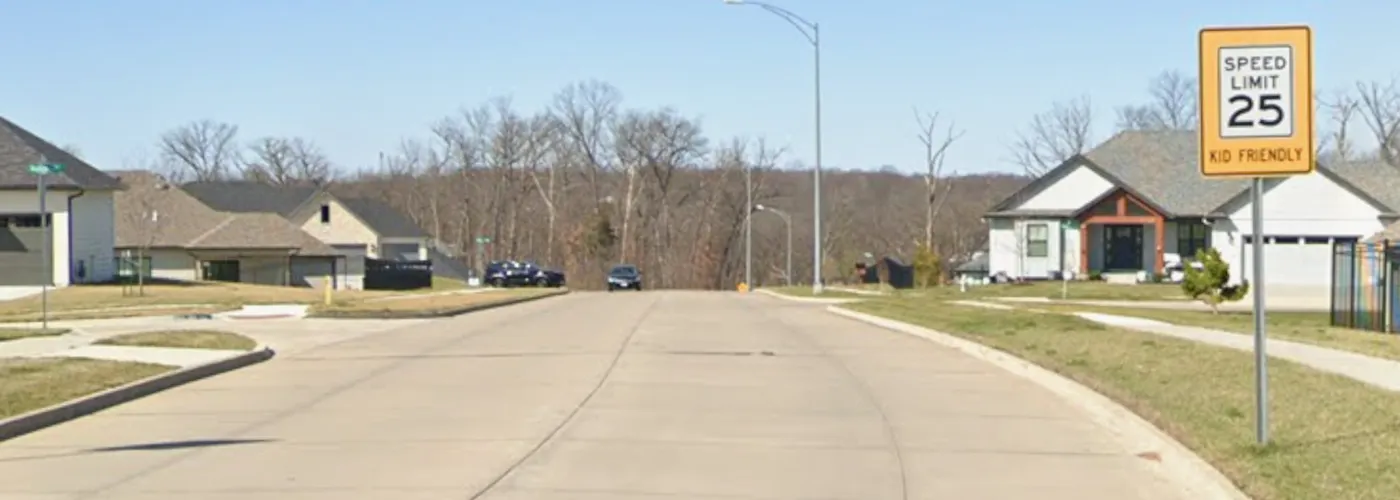
Hoylake Drive has been identified by a traffic study as having vehicles operating at speeds higher than desirable. The City of Columbia Public Works department is beginning a traffic calming project for the corridor and is seeking public input on potential solutions.
An informal open house meeting was held June 4 at City Hall. Residents and community members were able to review potential traffic calming concepts, ask questions and share feedback with City engineering staff.
Project information and diagrams were available for public review at the meeting and are on this page. Public comments were accepted through June 19 and will be considered as designs are developed.
In the Documents section, you can find the following files:
Hoylake Drive Presentation from June 4, 2026, meeting – A PowerPoint document from the June 4, 2026, meeting that shows different options for traffic calming, such as speed humps, speed tables, raised crosswalks, bulb-outs, medians, and roundabouts. It lists common concerns, such as emergency vehicles, maintenance and snow removal. It also lists the cost for each of these types of traffic calming.
Hoylake Drive traffic calming project location – A map showing the project area on Hoylake Drive between East Broadway and South Rolling Hills Road.
Hoylake Drive speed study data – A map showing traffic volumes (the number of vehicles) traveling in the northbound and southbound directions, along with the 85th percentile speed measured during the traffic study. The 85th percentile speed is a commonly used traffic engineering measurement that represents the speed at or below which 85% of vehicles were traveling. For example, an 85th percentile speed of 38 mph means that 85% of drivers were traveling 38 mph or slower, while 15% were traveling faster than 38 mph.
Members of the public may attend any open meeting. For requests for accommodations related to disability, please call 573.874.CITY (2489) or email City@CoMo.gov. In order to assist staff in making the appropriate arrangements for your accommodation, please make your request as far in advance of the posted meeting date as possible.
NEW: The presentation from the June 4 meeting has been added to the "Documents" section. A photo from the meeting has been uploaded, too.
Hoylake Drive has been identified by a traffic study as having vehicles operating at speeds higher than desirable. The City of Columbia Public Works department is beginning a traffic calming project for the corridor and is seeking public input on potential solutions.
An informal open house meeting was held June 4 at City Hall. Residents and community members were able to review potential traffic calming concepts, ask questions and share feedback with City engineering staff.
Project information and diagrams were available for public review at the meeting and are on this page. Public comments were accepted through June 19 and will be considered as designs are developed.
In the Documents section, you can find the following files:
Hoylake Drive Presentation from June 4, 2026, meeting – A PowerPoint document from the June 4, 2026, meeting that shows different options for traffic calming, such as speed humps, speed tables, raised crosswalks, bulb-outs, medians, and roundabouts. It lists common concerns, such as emergency vehicles, maintenance and snow removal. It also lists the cost for each of these types of traffic calming.
Hoylake Drive traffic calming project location – A map showing the project area on Hoylake Drive between East Broadway and South Rolling Hills Road.
Hoylake Drive speed study data – A map showing traffic volumes (the number of vehicles) traveling in the northbound and southbound directions, along with the 85th percentile speed measured during the traffic study. The 85th percentile speed is a commonly used traffic engineering measurement that represents the speed at or below which 85% of vehicles were traveling. For example, an 85th percentile speed of 38 mph means that 85% of drivers were traveling 38 mph or slower, while 15% were traveling faster than 38 mph.
Members of the public may attend any open meeting. For requests for accommodations related to disability, please call 573.874.CITY (2489) or email City@CoMo.gov. In order to assist staff in making the appropriate arrangements for your accommodation, please make your request as far in advance of the posted meeting date as possible.
Share As someone who sits outside a lot of the day and who lives on the corner of Hoylake and Spyglass I frequently see people speeding through here as if it was a race track! Considering we also own security cameras I could prove to the city how bad it really is especially when students are back in session. Family’s walking there children and pets it seems to me that this should be a priority and should have already been done! Now the plan is what, to wait another year are you joking????? I wouldn’t care which one you pick to slow these idiots down but you need to do it sooner rather than later! on FacebookShare As someone who sits outside a lot of the day and who lives on the corner of Hoylake and Spyglass I frequently see people speeding through here as if it was a race track! Considering we also own security cameras I could prove to the city how bad it really is especially when students are back in session. Family’s walking there children and pets it seems to me that this should be a priority and should have already been done! Now the plan is what, to wait another year are you joking????? I wouldn’t care which one you pick to slow these idiots down but you need to do it sooner rather than later! on X (formerly Twitter)Share As someone who sits outside a lot of the day and who lives on the corner of Hoylake and Spyglass I frequently see people speeding through here as if it was a race track! Considering we also own security cameras I could prove to the city how bad it really is especially when students are back in session. Family’s walking there children and pets it seems to me that this should be a priority and should have already been done! Now the plan is what, to wait another year are you joking????? I wouldn’t care which one you pick to slow these idiots down but you need to do it sooner rather than later! on LinkedinEmail As someone who sits outside a lot of the day and who lives on the corner of Hoylake and Spyglass I frequently see people speeding through here as if it was a race track! Considering we also own security cameras I could prove to the city how bad it really is especially when students are back in session. Family’s walking there children and pets it seems to me that this should be a priority and should have already been done! Now the plan is what, to wait another year are you joking????? I wouldn’t care which one you pick to slow these idiots down but you need to do it sooner rather than later! link
As someone who sits outside a lot of the day and who lives on the corner of Hoylake and Spyglass I frequently see people speeding through here as if it was a race track! Considering we also own security cameras I could prove to the city how bad it really is especially when students are back in session. Family’s walking there children and pets it seems to me that this should be a priority and should have already been done! Now the plan is what, to wait another year are you joking????? I wouldn’t care which one you pick to slow these idiots down but you need to do it sooner rather than later!
simpleman
asked
3 months ago
Thank you for sharing your experience. We understand the concerns about vehicle speeds on Hoylake Drive and appreciate hearing from residents who observe traffic conditions on a daily basis.
The public comment period for this project remains open through June 19. City engineers are currently gathering feedback from residents, property owners and others who use the corridor. Comments received at the June 4 meeting and through the project BeHeard page will be reviewed and considered as potential traffic calming solutions are developed.
After the comment period closes, City staff will evaluate the feedback and develop a proposed solution based on engineering analysis and community input. That proposal is expected to be presented to the neighborhood at a second public meeting, currently anticipated for fall 2026.
If there is consensus on a proposed solution, the project would then be presented to the City Council for a public hearing and vote before any traffic calming measures are installed.
We understand that many residents would like to see improvements implemented as soon as possible. The purpose of this process is to ensure that the proposed solution is informed by public input and receives appropriate public review before a final decision is made.
Share
Is there any information out there about how the city designs arterial, collector, and local roads? I feel like we are always managing speeds on the collector and arterial roads when they are supposed to be for handling more traffic and increasing traffic mobility. Is it possible that some of these collector roads should be at 35 mph? on FacebookShare
Is there any information out there about how the city designs arterial, collector, and local roads? I feel like we are always managing speeds on the collector and arterial roads when they are supposed to be for handling more traffic and increasing traffic mobility. Is it possible that some of these collector roads should be at 35 mph? on X (formerly Twitter)Share
Is there any information out there about how the city designs arterial, collector, and local roads? I feel like we are always managing speeds on the collector and arterial roads when they are supposed to be for handling more traffic and increasing traffic mobility. Is it possible that some of these collector roads should be at 35 mph? on LinkedinEmail
Is there any information out there about how the city designs arterial, collector, and local roads? I feel like we are always managing speeds on the collector and arterial roads when they are supposed to be for handling more traffic and increasing traffic mobility. Is it possible that some of these collector roads should be at 35 mph? link
Is there any information out there about how the city designs arterial, collector, and local roads? I feel like we are always managing speeds on the collector and arterial roads when they are supposed to be for handling more traffic and increasing traffic mobility. Is it possible that some of these collector roads should be at 35 mph?
Sarahj
asked
4 months ago
Thank you for the question. The City uses several standards and policies when designing and evaluating arterial, collector and local streets. One of the primary local guiding documents is Appendix A of Chapter 29 of the City of Columbia Code of Ordinances, which serves as the basis for the City’s Complete Streets policy. That document can be viewed at https://library.municode.com/mo/columbia/codes/code_of_ordinances?nodeId=COORCOMI_CH29UNDECO_APXASTST.
In addition to local policy, the City also follows nationally recognized engineering guidance and standards, including the AASHTO Green Book and the Manual on Uniform Traffic Control Devices (MUTCD). These resources help guide roadway design, traffic operations and safety considerations for different roadway types and contexts.
Roadway classifications like arterial, collector and local are used to balance mobility, livability, access to homes and businesses, and safety for all roadway users. Speed limits and traffic calming considerations are evaluated individually based on factors such as roadway geometry, adjacent land uses, crash history, traffic volumes, pedestrian activity and observed operating speeds.
Many streets and subdivisions are initially constructed by private developers, with plans reviewed by the City’s Building and Site Development staff to help ensure infrastructure meets adopted City standards and engineering requirements before being accepted into the public system.




Thank you for your contribution!
Help us reach out to more people in the community
Share this with family and friends